Table of Contents
The complexities of owning and developing land and property are in itself difficult to navigate, and becomes a little trickier when bodies of water are involved
A country comprised of thousands of islands, the Philippines has numerous bodies of water. These are being managed by laws that address their usage, ownership, and appropriation, among others.
Like real estate, not all bodies of water are the same, making it important for owners and developers to understand the policies that may apply to their properties and the waterways in or around them to avoid legal, financial, or environmental ramifications from misuse.
In this edition of Lamudi Q&A, we discuss what laws govern land or properties in relation to bodies of water.
Q: What Laws Govern Land Ownership in Relation to Bodies of Water?
On December 31, 1976, Presidential Decree (P.D.) No. 1067, or the Water Code of the Philippines, was signed into law to govern the use and ownership of water in the country. Its underlying principles are:
- All waters belong to the State;
- All waters that belong to the State cannot be subject to acquisitive prescription;
- The State may allow the use or development of waters by administrative concession;
- The utilization, exploitation, development, conservation and protection of water resources shall be subject to the control and regulation of the government through the National Water Resources Board;
- Preference in the use and development of waters shall consider current usages and be responsive to the changing needs of the country.
When Your Property Is by the Riverbank, Lakeshore, or Seashore
While much of P.D. 1067 deals with the bodies of water themselves, some provisions of the law also applies to the land where the bodies of water are located. For example, if you own a property that happens to be by the sea or by a river, you maintain your right to ownership of the land, which comprises the bank or shore. However:
Article 51: The banks of rivers and streams and the shores of the seas and lakes throughout their entire length and within a zone of three (3) meters in urban areas, twenty (20) meters in agricultural areas and forty (40) meters in forest areas, along their margins are subject to the easement of public use in the interest of recreation, navigation, floatage, fishing and salvage. No person shall be allowed to stay in this zone longer than what is necessary for recreation, navigation, floatage, fishing or salvage or to build structures of any kind.
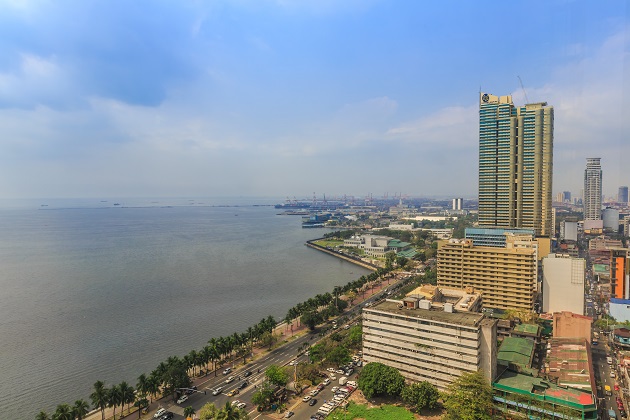
As a property owner, you must keep this in mind in the event that you plan to develop or alter the area near the bank or the shore, as it would likely become a wasted expense should it later become subject to public easements. A popular example of a public easement placed on a privately held land that is by the water is that of the SM Mall of Asia, where the 42-hectare property developed by SM Prime Holdings sits between Seaside Boulevard and Manila Bay.
When Your Property Is Downstream or Upstream
If the property you own or want to buy is located downstream, you are, by law, “obliged to receive the waters which naturally and without the intervention of man flow from the higher estate, as well as the stone or earth which they carry with them.” This means you cannot build anything on your property that would impede the natural flow of the waterway passing through your property, unless you are capable of developing an alternative method of drainage.
Conversely, if the property happens to be upstream, Article 50 of P.D. 1067 states that you also cannot build structures that will increase the natural flow of the body of water and, subsequently, the burden to the properties located downstream). In the event that there are descending waters resulting from artificial development or industrial establishments, or come from the overflow of irrigation dams, then a lower estate becomes entitled to compensation for losses or damage.
When Your Property Is in a Flood-Prone Area
It makes sense that areas near or near water are more likely to experience flooding. If your home is located in one of these areas, additional laws and regulations may apply. According to P.D. 1067 Article 53, which changes depending on what the local government imposes, implies the necessity “to ban or limit actions that may harm or cause degradation to lakes and dikes, obstruct the flow of water, modify the natural flow of the river, increase flood losses or aggravate flood problems.”
In addition, your property would probably be larger than it would be if it weren’t in a designated flood plain, making it vulnerable to public easements. The government is authorized by law to build the necessary flood-control structures “as broad as may be needed along and adjacent to the river bank and outside of the river bed or channel” in order to ensure public safety and prevent flooding.

When Considering the Conservation or Protection of Waters, Watersheds, and Related Land Resources
The government may limit real estate activity, or outright ownership, of property given its location near a body of water or its landscape.
Article 67: Any watershed or any area of land adjacent to any surface water or overlying any ground water may declared by the Department of Natural Resources as protected area. Rules and regulations may be promulgated by such Department to prohibit or control such activities by the owners or occupants thereof within the protected area which may damage or cause the deterioration of the surface water or ground water or interfere with the investigation, use, control, protection, management or administration of such waters.”
Indeed, several laws, including P.D. 1067, apply to land that is near or has rivers and legislation on legal easements that is related to it. These are just a few of the issues you would run into if you own, were looking to buy, or were looking to rent such real estate. It is believed that no two properties are the same; thus, it is always advised to speak with a lawyer and real estate professionals first to have a deeper understanding of what you can and cannot do with your home.
Before buying a property through online platforms like Lamudi, it is important to visit the area to see if there are potential problems that may occur in the future. You can also check the water code of the Philippines if you wish to learn more about how land ownership can be affected by the surrounding bodies of water.
References: www.gov.ph, www.neda.gov.ph, and assistance from Arch. Neil Cristobal or Rchitects, Inc.
Main image via Shutterstock